⚡ Quick answer:

All Yoga Training is our top overall pick for students who want an intensive Ashtanga Vinyasa-based immersion with substantial teaching practice in a beachfront setting. Ulu Yoga is the strongest flexible-format option, Inner Yoga stands out for boutique Vinyasa + Yin training, and Maharishi Yoga Peeth is one of the better-value traditional residential choices.

Editorial disclosure: This comparison is published by All Yoga Training, which is included at #1. We use the same criteria for every school and identify where a fact comes from a school’s own published information. Prices, formats and dates were re-checked against current school pages on August 21, 2026.

We compared 9 established Bali programs by teaching practice, faculty and curriculum depth, cohort transparency, training format, location, published student outcomes and total value. Where a school offers tuition-only, hybrid or room-dependent pricing, we flag that so the numbers are not misleading.

How we ranked Bali’s top yoga teacher trainings

We gave the most weight to factors that affect what happens after you arrive: whether you actually practice teaching, how much feedback you can receive, who teaches the core subjects, and whether the curriculum is coherent rather than simply long.

  • Teaching practice: supervised cueing, sequencing, class delivery and actionable feedback.
  • Faculty: experienced lead teachers and subject specialists rather than an unclear rotating roster.
  • Curriculum: a credible balance of practice, anatomy, philosophy and teaching methodology.
  • Cohort transparency: published group limits or clear information about how much individual attention students can expect.
  • Format: how much of the 200 hours is actually in person versus online, especially for accelerated programs.
  • Value: the realistic cost after accommodation and meals are added—not just the lowest advertised tuition.
  • Location and fit: whether the environment supports the type of immersion the school promises.

Top 9 Bali school comparison table (2026)

Starting prices are a snapshot checked August 21, 2026.

Some are tuition-only, promotional or room-dependent. Always confirm the total cost and inclusions for your exact dates.

Best Bali YTT programs

01

All Yoga Training Bali

Best overall for intensive practice + teaching confidence.
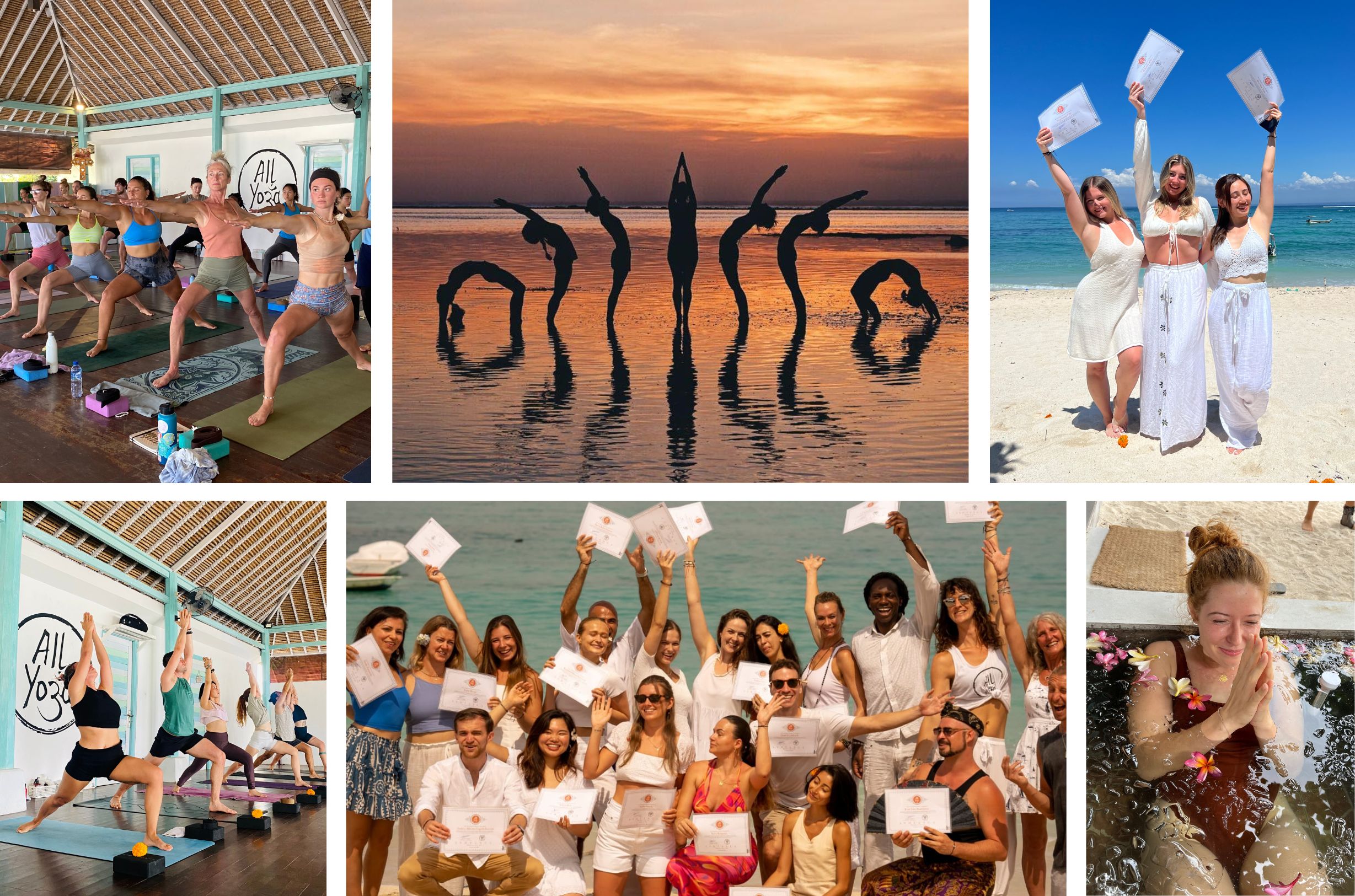
All Yoga Training Bali students practicing at the Nusa Lembongan beachfront shala
Starting Price
USD 3,150
Location
Nusa Lembongan
Class size
24 students max
Duration
23 days
Styles:
Ashtanga VinyasaRocket YogaVinyasaYin
Features:
Beachfront shalaYoga Alliance registeredResidential24-student cap

School overview

All Yoga Training has been running yoga teacher trainings since 2009 and holds its flagship Bali program on Nusa Lembongan, a small island off Bali’s southeast coast. The course runs for 23 days at a dedicated beachfront shala, with cohorts capped at 24 students. According to the school, more than 3,500 students have completed its trainings since 2009.

The location is part of the format rather than just the backdrop. Nusa Lembongan is much smaller and quieter than Ubud or Canggu, so there are fewer opportunities to disappear into restaurants, nightlife and traffic once class finishes. For an intensive course, I think that matters. The downside is that getting there requires an additional boat transfer from mainland Bali.

Program overview

The curriculum has a clear Ashtanga Vinyasa backbone. Students use that structured practice to study alignment, breath, transitions and sequencing before applying those principles to more creative Vinyasa and Rocket-style teaching. Yin is included as a counterpoint to the stronger dynamic focus, but this is not a Yin-led or general multi-style course.

The part I’d pay most attention to is the teaching methodology. All Yoga Training puts students into teaching situations throughout the immersion rather than treating teaching as a final-week assessment. Cueing, sequencing, demonstrations, alignment, adjustments and class delivery are practised repeatedly, with feedback used to refine how students actually communicate a class.

That makes the course a stronger fit for somebody who wants to leave Bali ready to start teaching, not simply deepen their own practice and decide about teaching later. The Ashtanga foundation also gives the course more structure than programs trying to cover five or six physical styles equally inside the same 200 hours.

It is still an intensive 23-day training. Expect long days and a substantial physical workload. If your idea of a Bali YTT is closer to a wellness retreat with plenty of unstructured time, I’d look elsewhere. If you want the training itself to dominate the trip, the format makes much more sense.

Pros
  • Clear Ashtanga Vinyasa foundation rather than trying to give equal weight to too many styles
  • Strong emphasis on teaching practice, cueing, sequencing and class delivery throughout the course
  • 24-student maximum provides a published ceiling on cohort size
  • Nusa Lembongan offers fewer distractions than Bali’s larger yoga hubs
  • Established school operating since 2009
Cons
  • Requires a boat transfer from mainland Bali to Nusa Lembongan
  • Physically intensive format won’t suit students looking for a retreat-first experience
  • Students wanting a primarily Yin, Hatha or restorative education should choose a more specialised curriculum
View All Yoga Training Course Details →
02

Ulu Yoga

Best for flexible formats and multi-style exploration.

Ulu Yoga teacher training in Uluwatu Bali
Starting Price
USD 1,600
Location
Uluwatu / Bingin
Class size
14–24 students
Duration
10–28 days
Styles:
HathaVinyasaYinAerialAcro
Features:
Ocean-view shalaFlexible formatsHybrid optionRYS 200

School overview

Ulu Yoga runs its Bali teacher training from Uluwatu near Bingin Beach, putting students in one of the island’s main surf and beach areas rather than the inland yoga scene of Ubud. The training takes place at an ocean-view shala and the school is registered as a Yoga Alliance RYS 200.

Its biggest differentiator is format flexibility. Ulu Yoga offers 10-, 14-, 21- and 28-day routes to the 200-hour training. The shorter versions combine in-person study in Bali with online coursework, while the 28-day option completes the program fully in person.

That’s genuinely useful if taking four weeks away from work isn’t realistic. It also means you need to compare the formats properly. A 10-day Bali immersion plus online study is a very different learning experience from spending 28 days with teachers and classmates in person, even if both routes ultimately sit under the same 200-hour qualification.

Program overview

Hatha and Vinyasa form the core of the program. Students work through alignment, functional anatomy, sequencing, teaching methodology, adjustments and practical teaching, with additional exposure to Yin yoga. Ulu Yoga also introduces aerial and acro yoga, which makes the physical curriculum broader than most of the schools in this comparison.

I wouldn’t choose it purely because it teaches the most styles. More styles aren’t automatically better in a 200-hour course. The appeal is that students who are still figuring out what they enjoy teaching can experience several approaches while keeping Hatha and Vinyasa as the main foundation.

Teaching practice is built into the course, with students working on cueing, demonstrations, sequencing and feedback. That’s particularly important if you’re considering one of the shorter hybrid formats: I’d check exactly how much live teaching practice happens during your Bali component and how the online hours are divided before booking.

Uluwatu itself will suit people who want beach life around the training. It is less walkable than central Ubud and getting between beaches, accommodation and cafés often means arranging transport. For some students that’s a minor inconvenience. For others, having everything within walking distance matters after a long training day.

Pros
  • 10-, 14-, 21- and 28-day formats make the program unusually flexible
  • Fully in-person option is available for students who don’t want a hybrid qualification
  • Core Hatha and Vinyasa training is supplemented by Yin, aerial and acro yoga
  • Teaching practice and feedback are included rather than leaving the course entirely theory-led
  • Uluwatu location works well for students who want beaches and surf around their training
Cons
  • Shorter formats include a substantial online component
  • Broad style exposure gives less room for deep specialisation in one method
  • Starting tuition and residential packages are not directly comparable
  • Uluwatu is spread out, so transport can be more important than in a compact retreat setting
View Ulu Yoga Program →
03

Loka Yoga School

Best for a long-form, multidisciplinary curriculum.

Loka Yoga School teacher training in Kedungu Bali
Starting Price
USD 2,700
Location
Kedungu
Class size
20 students max
Duration
28 days
Styles:
HathaVinyasaAshtangaYinBreathwork
Features:
Rice-field setting28-day residential20-student capMovement science

School overview

Loka Yoga School runs a 28-day residential 200-hour training in Kedungu, west of Canggu. The setting is quieter and more rural than Bali’s main yoga hubs, and groups are capped at 20 students. Of the schools in this comparison, Loka is one of the better fits for somebody who actively wants a full month of training rather than the fastest route through 200 hours.

The school positions its approach between traditional yoga and modern movement science. That’s a useful distinction because the curriculum isn’t built exclusively around memorising a fixed sequence or studying philosophy. Biomechanics, functional movement and anatomy sit alongside more traditional practices.

Kedungu also changes the experience. You’re close enough to the coast and Canggu region to avoid feeling completely cut off, but you’re not training in the middle of Canggu’s traffic and nightlife. If having a large social scene outside class matters, that could feel quiet. For an immersive month, I’d see it as more of an advantage.

Program overview

The curriculum covers Hatha, Vinyasa, Ashtanga and Yin alongside biomechanics, functional anatomy, breathwork, meditation, yoga philosophy, yoga nidra, Sanskrit, sequencing and teaching methodology. It’s a wide syllabus, but the 28-day format gives the school more time to work through it than programs compressing similar material into 18 or 20 days.

The movement-science component is the bit that differentiates Loka most clearly. Students aren’t only learning what a posture is supposed to look like; the curriculum puts more attention on how bodies move, how alignment varies between people and how teachers can think about movement rather than mechanically reproducing shapes.

That should appeal to students who want anatomy and biomechanics to influence the way they teach. If what you’re really after is a strong single-style lineage, however, the breadth becomes less compelling. Someone committed to Ashtanga alone may get more from a narrower course where most of the physical training stays inside that system.

Current 2026 pricing lists a training option from USD 2,700, with more complete residential packages costing more depending on accommodation. As with the other schools offering multiple package levels, compare the room and inclusions you would actually choose rather than ranking the course on its lowest advertised figure.

Pros
  • 28-day format gives students more time to absorb a broad curriculum
  • Maximum 20 students provides one of the smaller published cohort limits in this comparison
  • Biomechanics and movement science add a useful layer to traditional anatomy and alignment study
  • Breathwork, meditation and yoga nidra broaden the course beyond physical practice
  • Kedungu offers a quieter environment than central Canggu
Cons
  • Four-week format requires a bigger time commitment
  • Kedungu is removed from the convenience and social life of central Canggu and Ubud
  • Broad multidisciplinary curriculum is less suitable for students seeking deep specialisation in one lineage
  • Total residential cost depends on the accommodation package selected
View Loka Yoga Program →
04

Bali Yoga Center

Best for a straightforward Hatha, Ashtanga and Vinyasa foundation in Ubud.

Bali Yoga Center 200 hour training in Ubud
Starting Price
USD 1,300
tuition
Location
Ubud
Class size
Not clearly stated
Duration
21 days
Styles:
HathaAshtangaVinyasa
Features:
UbudTuition-only optionResidential optionTeaching methodology

School overview

Bali Yoga Center is one of the more traditional choices in this list. The 21-day course works across Hatha, the Ashtanga Primary Series and Vinyasa rather than committing heavily to one modern style. That makes it a sensible option if you’re still developing your own practice and want exposure to several common approaches before deciding what you actually want to teach.

The Ubud location is another part of the appeal. You’re training in Bali’s main yoga hub rather than an isolated retreat, so there are plenty of studios, cafés and wellness businesses around you. Some people will love having that choice on their doorstep. If you want to disappear completely into the course for three weeks, a quieter island or rural program may suit you better.

Program overview

The physical practice is only one part of the syllabus. Students also study pranayama, meditation, yoga philosophy, anatomy and physiology, alignment and injury prevention. The teaching-methodology component covers class planning, the language used to teach postures, demonstrations, adjustments and assisting students. In other words, it isn’t simply three weeks of doing asana and collecting a certificate at the end.

What I’d pay attention to here is the breadth. Learning Hatha, Ashtanga and Vinyasa gives a new teacher several reference points, but it also means the 200 hours are divided across more material. If you already know that you want a very specialised Ashtanga, Yin or Vinyasa education, I’d compare it with a school built specifically around that style.

The pricing structure is useful if you already have accommodation in Ubud. Tuition-only starts from USD 1,300, while residential options cost more depending on the room. Don’t compare the USD 1,300 figure directly with an all-inclusive course until you’ve added your accommodation and food for the full 21 days.

Pros
  • Good spread of Hatha, Ashtanga Primary Series and Vinyasa for students who don’t want to specialise too early
  • Teaching methodology covers class planning, instruction, adjustment and assisting
  • Tuition-only option makes sense if you already plan to stay in Ubud
  • Includes anatomy, philosophy, pranayama and meditation alongside physical practice
Cons
  • No clear maximum cohort size is prominently published
  • Broad multi-style coverage means less specialisation in any one method
  • Headline tuition price excludes the accommodation costs many international students will need
View Bali Yoga Center Program →
05

Maharishi Yoga Peeth

Best value for students who want a traditional residential course rather than a retreat-style YTT.

Maharishi Yoga Peeth yoga teacher training in Ubud Bali
Starting Price
USD 1,899
shared
Location
Ubud
Class size
Small groups (no fixed cap published)
Duration
20 days
Styles:
HathaAshtangaVinyasa Flow
Features:
ResidentialThree vegetarian mealsTraditional curriculumShared & private rooms

School overview

Maharishi Yoga Peeth takes a fairly traditional approach to its 200-hour training. Hatha, Ashtanga and Vinyasa Flow form the physical base, but the timetable also gives space to pranayama, meditation, mantra, philosophy and the less glamorous parts of learning to teach properly.

This is less of a boutique Bali wellness experience and more of a structured residential yoga course. That’s an important distinction. If your priority is a beautiful resort and lots of free time, there are better fits in this list. If you want to live around the training for 20 days and keep the total cost relatively contained, Maharishi becomes much more interesting.

Program overview

The teaching component is more detailed than the old price-led description made it sound. The published syllabus includes demonstrations, observation, assisting and correcting students, use of voice, class preparation, time management and step-by-step class structure. Those are practical skills you’ll actually need once you’re standing in front of a room rather than following somebody else’s class.

There is also a substantial traditional layer. Alongside anatomy and asana, students work with pranayama, meditation and mantra chanting. So I’d put Maharishi higher on the shortlist for someone who wants yoga philosophy and traditional practices integrated into the day, and lower for somebody mainly looking for contemporary movement science or a specialised Yin curriculum.

The residential pricing is one of its strongest points. Shared accommodation starts from USD 1,899 and private rooms from USD 2,699 for the published 2026 dates. Accommodation and three vegetarian meals are included, which makes the shared option easier to budget than schools advertising tuition first and adding living costs later.

Pros
  • Residential package gives you a clearer idea of the real trip cost
  • Teaching methodology goes into voice, class planning, observation, assisting and corrections
  • Strong traditional component alongside Hatha, Ashtanga and Vinyasa Flow
  • Good fit for students who want pranayama, meditation and mantra to be part of the training rather than optional extras
Cons
  • No consistent numeric maximum cohort size is clearly published
  • Traditional teaching style won’t be the right fit for students wanting a modern boutique training
  • The 20-day schedule is fairly compressed for the amount of material covered
View Maharishi Yoga Peeth Program →
06

Vinyasa Yogashala

Best for budget-conscious students who still want a traditional, content-heavy syllabus.

Vinyasa Yogashala 200 hour yoga course in Bali
Starting Price
USD 649
limited shared
Location
Bali
Class size
Not clearly stated
Duration
20 days
Styles:
HathaAshtanga VinyasaMeditationPranayama
Features:
Tiered room pricingBudget entry price20-day formatTraditional syllabus

School overview

The USD 649 starting price is what grabs attention here, but Vinyasa Yogashala isn’t simply a stripped-back budget course. Its published 200-hour curriculum is extensive and fairly traditional, combining Hatha and Ashtanga Vinyasa with pranayama, meditation, philosophy, anatomy, teaching methodology and mantra practice.

The better reason to consider it is the amount of subject matter packed into the 20-day format. There is a clear emphasis on yogic practice beyond asana, so this should appeal more to someone who wants the traditional framework around yoga than to a student looking for a narrow, modern Vinyasa certification.

Program overview

The curriculum moves between physical practice and traditional study throughout the course. Hatha and Ashtanga Vinyasa provide the asana base, while pranayama covers multiple breathing techniques and meditation is taught through several methods rather than as a single daily sit. The syllabus also includes anatomy, philosophy, posture adjustment, sequencing and teaching methodology.

There is quite a lot of mantra and chanting content too. That’s either a strength or unnecessary weight depending on why you’re doing a YTT. If you want a broader education in traditional yogic practices, it adds substance. If your only goal is becoming a confident studio Vinyasa teacher, I’d pay closer attention to how much supervised teaching and individual feedback your particular cohort receives.

And then there’s the price. The USD 649 rate applies to limited four-sharing accommodation, so it shouldn’t be treated as the normal cost of attending. Three-share, twin and private options are progressively more expensive. Compare the room tier you would genuinely book, not the cheapest number on the page.

Pros
  • One of the lowest entry prices in this comparison
  • Substantial traditional syllabus covering more than physical asana practice
  • Hatha and Ashtanga Vinyasa are supported by pranayama, meditation, philosophy and anatomy
  • Several accommodation tiers let students trade privacy for a lower total cost
Cons
  • The USD 649 headline price is tied to limited four-sharing accommodation
  • No clear cohort cap is prominently published
  • There is a lot to cover in 20 days, so students should check how teaching practice is divided within the timetable
View Vinyasa Yogashala Program →
07

Inner Yoga Training

Best boutique option for students who genuinely want to learn both Vinyasa and Yin.

Inner Yoga Training residential course in Ubud Bali
Starting Price
USD 2,750
early bird
Location
Ubud
Class size
18 students max
Duration
20 days
Styles:
VinyasaYinTCMAyurveda
Features:
18-student capVinyasa + YinSpecialist teachersResidential

School overview

Inner Yoga is noticeably more specialised than most of the multi-style schools on this list. The 20-day program is built around Vinyasa and Yin, with the school describing the split as roughly 60% Vinyasa and 40% Yin. Groups are capped at 18, which is one of the smallest published limits in this comparison.

What makes it interesting isn’t simply that Yin appears on the timetable. Students work through the 26 foundational Yin postures and functional anatomy, while Traditional Chinese Medicine and meridian theory are used to add another layer to sequencing. If you actually want to teach Yin rather than collect a few Yin classes inside a general 200-hour course, that distinction matters.

Program overview

Vinyasa training focuses on building and teaching complete sequences for different bodies, levels and intentions. Yin is treated as a second teaching discipline rather than a recovery practice at the end of the day. Anatomy and biomechanics sit underneath both, with additional study in meditation, pranayama, yoga philosophy, Ayurveda and Traditional Chinese Medicine.

Teaching starts during the course rather than being saved for a final assessment. Students practise cueing, guiding and sequencing, receive feedback, and work towards teaching complete 60-minute Vinyasa and Yin classes. There is also a business module covering practical routes into studio, retreat and online teaching.

I like the use of specialist teachers here. Inner Yoga publishes separate faculty for Vinyasa/anatomy, Yin, philosophy/Ayurveda and Traditional Chinese Medicine instead of presenting one lead teacher as an expert in everything. The trade-off is obvious: if you’re specifically looking for a strong Ashtanga lineage or Rocket practice, this isn’t the course I’d choose.

Pros
  • Genuine Vinyasa and Yin depth rather than a token Yin module
  • Maximum 18 students gives the school one of the smaller published cohorts in this comparison
  • Specialist faculty teach distinct subjects including anatomy, philosophy, Ayurveda and TCM
  • Students work towards teaching complete Vinyasa and Yin classes
  • Functional anatomy and TCM give the Yin component more depth than a standard multi-style YTT
Cons
  • Not the right fit if Ashtanga or Rocket is your main practice
  • Higher starting price than the budget schools in this list
  • The Vinyasa/Yin specialisation is less useful if you want broad exposure to many yoga styles
Check Inner Yoga Dates & Prices →
08

School Yoga Institute

Best for students who want spiritual practice and self-inquiry to carry as much weight as asana.

School Yoga Institute 200 hour training in North Bali
Starting Price
USD 2,200
tuition + room/board
Location
Tejakula / North West Bali
Class size
Not clearly stated
Duration
21 days
Styles:
HathaVinyasaMeditationMystical Yoga
Features:
North BaliPeer teaching from day oneSpiritual curriculum21-day format

School overview

School Yoga Institute is the outlier in this comparison, and that’s probably the best way to understand it. The 200-hour course teaches Hatha and Vinyasa, but the school’s “Mystical Yoga” framework puts much more emphasis on spiritual practice, self-inquiry and ceremony than a conventional studio-focused teacher training.

The Bali courses run in quieter northern locations including Tejakula and North West Bali. You’re well away from the café-and-studio rhythm of Ubud or Canggu, which suits the course. This is designed as an immersion. If you want plenty happening outside training hours, the isolation could feel restrictive rather than peaceful.

Program overview

Students learn two main teaching sequences: a slower Hatha-based flow and a more dynamic Vinyasa flow. The practical side includes alignment, sequencing, anatomy and physiology, adjustments and what the school calls the Art of Teaching. Peer teaching begins from day one, which is a meaningful positive for anyone nervous about getting in front of a class.

The other half of the experience is much less conventional. The curriculum works through the Peruvian Medicine Wheel and includes daily meditation, pranayama, satsang, kirtan and ceremonies that can include cacao, gratitude and letting-go practices. That’s not a minor side module; it’s part of the identity of the training.

So this one is easy to qualify. I’d shortlist School Yoga Institute if you’re looking for yoga training as a spiritual immersion and like the idea of Hatha/Vinyasa teaching skills sitting alongside ceremony and self-inquiry. I wouldn’t choose it simply because you want a Yoga Alliance certificate and the most direct route into teaching modern studio classes.

Pros
  • Peer teaching begins from day one rather than being held until the end of the course
  • Students learn defined Hatha and Vinyasa teaching sequences plus how to create their own
  • Quiet North Bali locations support a genuine retreat-style immersion
  • Strong meditation, pranayama and spiritual-practice component
Cons
  • The Peruvian Medicine Wheel and ceremonial elements will be a strong positive for some students and a reason not to book for others
  • Remote location offers less freedom than Ubud or Canggu
  • Tuition and room-and-board costs need to be combined when comparing it with all-inclusive schools
Check School Yoga Institute Dates →
09

The Peaceful Warriors

Best for a broad teacher-training curriculum with Canggu life outside the classroom.

The Peaceful Warriors yoga teacher training in Canggu Bali
Starting Price
USD 2,650
early bird
Location
Canggu
Class size
25 students max
Duration
27 days
Styles:
HathaVinyasaYinRestorative
Features:
Canggu25-student cap27-day formatBroad curriculum

School overview

The Peaceful Warriors has been running teacher trainings in Canggu since 2017. Of the programs in this comparison, it’s one of the better fits for someone who wants a substantial in-person course without disappearing into an isolated retreat. You still have Canggu’s cafés, gyms, beaches and social scene around you once classes finish.

That can work both ways. Canggu gives you more independence and a lot more to do, but it’s also busy, traffic-heavy and very easy to get distracted. I’d choose the location because you actually want that balance, not because Canggu happens to be one of the best-known places in Bali.

Program overview

The 27-day format gives The Peaceful Warriors more room than many three-week courses to cover its very broad syllabus. Hatha and Vinyasa form the main physical teaching framework, with dedicated work on sequencing, posture alignment, cueing and adapting classes for different populations, including beginners and older students.

From there, the curriculum gets wide. Anatomy and physiology, pranayama, meditation, yoga history and philosophy, the subtle body, Ayurveda, prenatal yoga, yoga psychology, ethics and business and marketing all appear in the program. Yin and restorative practices add further exposure beyond the Hatha/Vinyasa base.

The practical angle is what I’d focus on. Learning how to sequence a class is useful, but learning how to change that class for the actual person standing in front of you is closer to the reality of teaching. The school also offers online material, which gives graduates something to revisit after the intensity of the in-person month has worn off.

The downside is that breadth always comes at a cost. There are a lot of subjects competing for 200 hours, so students wanting deep specialisation in Ashtanga, Yin or anatomy may prefer a narrower course. Accommodation is also separate from the training fee, so budget for Canggu living costs before comparing the headline price with residential programs.

Pros
  • 27-day format gives the curriculum more breathing room than many compressed courses
  • Teaching content includes sequencing, alignment and adapting classes for different students
  • Broad supporting curriculum covering anatomy, philosophy, pranayama, meditation and the business of teaching
  • Canggu suits students who want an active social environment outside training hours
  • Online study material gives graduates something practical to revisit after the course
Cons
  • Accommodation is additional to the course fee
  • Canggu is busy and can be distracting during an intensive training
  • Very broad curriculum means less depth in individual specialist styles
Check Peaceful Warriors Dates →

How to choose the right Bali YTT for you

The ranking above is a starting point, not a universal answer. A school can be excellent and still be wrong for your practice style, budget or preferred learning environment. Compare these five questions before you commit.

How much real teaching will you do?

Ask when supervised teaching begins, how often you teach, and whether feedback is individual or mostly group-based.

Who will teach your exact cohort?

A famous founder on the website is less relevant if a different rotating team delivers your dates.

What is the real group size?

Published cohort limits make it easier to estimate how much feedback and mentoring you can realistically receive.

Is the lowest price actually comparable?

Add accommodation, meals, required online modules, transport and certification-related costs before judging value.

Does the yoga style match the teacher you want to become?

An Ashtanga-led course, multi-style course and Vinyasa/Yin course can all meet 200-hour standards while producing very different experiences.

If you want to compare another Bali-focused training option before making a decision, Explore Yoga Teacher Training in Bali for additional course information.

Which Bali training location fits your learning style?

Location Atmosphere Main advantage Trade-off
Nusa Lembongan Small island, beach-focused Fewer distractions and strong immersion Requires a boat transfer from Bali
Ubud Cultural, wellness-oriented, inland Huge choice of yoga, food and wellness services Traffic and tourism can be intense
Uluwatu / Bingin Coastal, surf-oriented Beach access and a more open coastal feel Getting around often requires transport
Canggu Busy surf / digital-nomad hub Cafés, gyms, nightlife and social scene Traffic and distractions
Kedungu / North Bali Quiet and rural Deeper retreat atmosphere Less access to central Bali

When Bali is—and is not—the right place to train

Reasons Bali works well
  • Large choice of established international training schools and styles.
  • Residential formats make it easier to step away from normal routines.
  • Options range from busy Ubud and Canggu to quieter island and North Bali settings.
  • Competitive total costs compared with many residential trainings in Europe, Australia or North America.
Reasons to consider somewhere else
  • Flights can erase the price advantage if you live far from Southeast Asia.
  • Compressed 200-hour schedules are physically and mentally demanding.
  • Popular areas can feel crowded and highly commercial.
  • If you want a specific local teacher or lineage, destination should be secondary to faculty fit.

Questions to ask before choosing a Bali YTT

Which Bali YTT ranks #1 in this comparison?

All Yoga Training is our #1 overall pick for 2026 because its 23-day Nusa Lembongan program combines a defined Ashtanga Vinyasa foundation, substantial teaching practice, a beachfront training environment and a published 24-student cap. This ranking is published by All Yoga Training, so that relationship is disclosed and the same comparison criteria are applied to every school.

Which programs have the smallest published groups?

Among the schools in this ranking with clear numeric limits, Inner Yoga publishes a maximum of 18 students, Loka Yoga School 20, All Yoga Training 24, Ulu Yoga 14–24 depending on the format, and The Peaceful Warriors 25. For schools that do not publish a clear cap, ask for the expected number on your exact dates.

How should I compare prices fairly?

Compare the total cost for the format you will actually book. Some schools advertise tuition only, while others include accommodation and meals. Also check whether the lowest price requires a shared room, early-bird booking or online study. The cheapest headline number is often not the cheapest final trip.

Which area of Bali is best for teacher training?

Nusa Lembongan and North Bali suit students who want fewer distractions; Ubud offers the deepest wellness ecosystem; Uluwatu combines training with beaches and surf; Canggu is the most social and convenient but also the busiest. The best location depends on the environment in which you learn best.

Should I choose a hybrid or fully in-person 200-hour course?

Hybrid formats can be excellent when time away is limited, but compare how much practical teaching, alignment work and feedback happens face-to-face. For students whose main goal is teaching confidence, the quality and duration of the in-person practicum matter more than whether the certificate itself says “hybrid.”

How current are the prices and program details on this page?

The main program facts and prices in this comparison were checked against current school pages on August 21, 2026. Yoga schools change prices, venues, faculty and dates frequently, so verify the final package directly before paying a non-refundable deposit.

Final Verdict:

There isn’t one program I’d call the best choice for every student. All Yoga Training is our overall pick if you want intensive practice and a strong emphasis on actually learning to teach. Ulu Yoga makes more sense when flexibility matters. Inner Yoga is the more specialised choice for Vinyasa and Yin, while Maharishi Yoga Peeth offers a traditional residential format at a comparatively accessible all-in price. School Yoga Institute is the obvious outlier if spiritual immersion is the priority, and The Peaceful Warriors suits students who want a broad curriculum without giving up the social side of Canggu. Build your shortlist around the kind of teacher you want to become, then compare the actual faculty, teaching hours, cohort size and total cost for your dates.

× Get in Touch!